
School of Artificial Intelligence & Generative AI · Advanced
MLOps & LLMOps Engineering Course
Learn how production AI actually operates: reproducible experiments, pipelines, CI/CD, serving, monitoring, governance and LLMOps.
Talk to an adviser on WhatsApp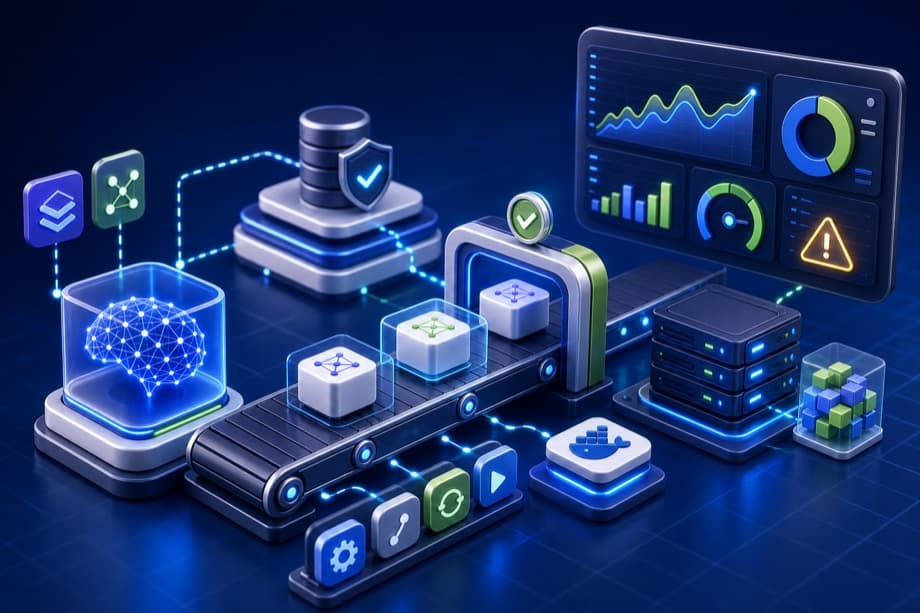
MLOps and LLMOps Operating ModelExperiment Tracking and ReproducibilityData and Training PipelinesCI/CD/CT for ML Systems
GitMLflowCloud ML platform conceptsW&BDVC
How you will learn
What you will learn, module by module
Learn the production ML/LLM lifecycle, observability, CI/CD, governance, and scalable serving. Progress from MLOps and LLMOps Operating Model to Governance, Security and Production Capstone through guided labs, assessed projects, and portfolio evidence.
01Module 1 · 6 hoursMLOps and LLMOps Operating ModelMap an existing ML project into an MLOps lifecycle with control points and ownership.
Topics you will cover
- ML/LLM lifecycle
- Environments
- Reproducibility
- Experiment versus production
- Roles
- Governance
- Platform architecture
- Maturity model
- Tools and platforms
- Git, MLflow, Cloud ML platform concepts
- Portfolio evidence
- MLOps operating model
- Assessment
- Architecture exercise
02Module 2 · 8 hoursExperiment Tracking and ReproducibilityTrack experiments and reproduce the best run from versioned code and configuration.
Topics you will cover
- Code/data/model versioning
- Experiment tracking
- Parameter and metric logging
- Artifacts
- Environment capture
- Lineage
- Tools and platforms
- MLflow/W&B, Git, DVC optional
- Portfolio evidence
- Tracked experiment repository
- Assessment
- Reproducibility lab
03Module 3 · 10 hoursData and Training PipelinesBuild an automated training pipeline with validation and failure handling.
Topics you will cover
- Pipeline DAGs
- Validation
- Feature pipelines
- Scheduled/retraining jobs
- Orchestration
- Artifact stores
- Data quality gates
- Tools and platforms
- Airflow/Prefect/Kubeflow/cloud pipelines
- Portfolio evidence
- Automated training workflow
- Assessment
- Pipeline lab
04Module 4 · 10 hoursCI/CD/CT for ML SystemsCreate CI/CD that tests, packages and promotes a model service through environments.
Topics you will cover
- Unit/integration/data tests
- Model checks
- Container builds
- Registries
- Promotion
- Continuous training
- Environment gates
- Tools and platforms
- GitHub Actions/GitLab CI, Docker, Registry
- Portfolio evidence
- ML CI/CD pipeline
- Assessment
- CI/CD checkpoint
05Module 5 · 10 hoursModel Serving and Scalable InferenceDeploy two model versions and run a safe canary or shadow release.
Topics you will cover
- Batch/online/streaming inference
- REST/gRPC concepts
- Autoscaling
- Canary/shadow/A-B deployment
- Latency
- Cost
- Rollback
- Tools and platforms
- FastAPI, Docker, Kubernetes/cloud serving
- Portfolio evidence
- Versioned inference service
- Assessment
- Serving lab
06Module 6 · 10 hoursLLMOps: Prompt, Model and Knowledge LifecycleCreate a release workflow for prompts, retrieval index and model configuration with regression tests.
Topics you will cover
- Prompt/version management
- Model routing
- RAG index lifecycle
- Evaluation gates
- Caching
- Token economics
- Model upgrades
- Rollback
- Tools and platforms
- LLM tracing/eval stack, Vector DB, Git
- Portfolio evidence
- Versioned GenAI release pipeline
- Assessment
- LLMOps release lab
07Module 7 · 10 hoursMonitoring, Drift and AI ObservabilityBuild monitoring dashboards and define alerts/SLOs for an ML or GenAI service.
Topics you will cover
- Infrastructure metrics
- Data/model drift
- Quality metrics
- Traces
- LLM latency/cost
- Groundedness
- Alerting
- Incident diagnostics
- Tools and platforms
- OpenTelemetry, Prometheus/Grafana or cloud monitoring
- Portfolio evidence
- AI operations dashboard
- Assessment
- Observability review
08Module 8 · 16 hoursGovernance, Security and Production CapstoneDeliver a production AI platform blueprint and automate a governed deployment for a model or LLM application.
Topics you will cover
- Model registry controls
- Secrets/IAM
- Auditability
- PII
- Responsible AI
- Approval workflows
- Risk tiering
- Disaster recovery
- Cost governance
- Tools and platforms
- MLflow/cloud ML, CI/CD, Docker/Kubernetes, Security tooling
- Portfolio evidence
- Governed MLOps/LLMOps platform project
- Assessment
- Capstone defence
Projects you will build
2 portfolio projects plus module evidence
Production AI Delivery Platform
Create a versioned training and deployment workflow with CI/CD, a registry, monitoring and rollback.
Pipeline code · Registry · Deployment · Dashboards · RunbookLLMOps Release System
Manage prompts, model configs, RAG index, evaluations and release gates.
Versioned assets · Regression evals · Trace dashboard · Release checklist Course value
Why this course
Production AI requires reproducible experiments, controlled releases, observability, governance, and clear operational ownership across both ML and LLM systems.
The curriculum progresses from MLOps and LLMOps Operating Model to Governance, Security and Production Capstone, with guided labs, assessments, and two portfolio projects: Production AI Delivery Platform and LLMOps Release System.
Who this course is for
ML/AI engineers, data scientists and platform engineers responsible for production AI systems.
AdvancedAI & Generative AI Engineer
PrerequisitesLearners should have machine-learning or GenAI project experience, along with familiarity with Git, Python, and basic cloud and container concepts.
What you will be able to do
- Map an existing ML project into an MLOps lifecycle with control points and ownership.
- Track experiments and reproduce the best run from versioned code and configuration.
- Build an automated training pipeline with validation and failure handling.
- Create CI/CD that tests, packages and promotes a model service through environments.
- Deploy two model versions and run a safe canary or shadow release.
- Build monitoring dashboards and define alerts/SLOs for an ML or GenAI service.
- Deliver a production AI platform blueprint and automate a governed deployment for a model or LLM application.
Technology you will use in this course
GitMLflowCloud ML platform conceptsW&BDVCAirflowPrefectKubeflowCloud pipelinesGitHub ActionsGitLab CIDockerFastAPIKubernetesCloud serving
Career relevance
AI & Generative AI Engineer
This course supports the development of skills relevant to roles such as MLOps Engineer, LLMOps Engineer, ML Platform Engineer, and AI Reliability Engineer. The strongest learner outcome is a portfolio that shows the problem, implementation, testing or evaluation, documentation and a clear explanation of decisions—not a certificate alone.
Course evidence and instruction
Discuss your learning pathway
Review prerequisites, learning format and project expectations with admissions before enrolment.
Get course guidanceExplore the course projects
Review the project briefs and deliverables to understand the work expected during the course.
Review project expectationsTechnology references
Technology names identify learning tools and do not imply an employer partnership or endorsement.
Microsoft

Clear answers before you enrol
Is the MLOps & LLMOps course suitable for beginners?
This is an advanced-level course. Learners should have machine-learning or GenAI project experience, along with familiarity with Git, Python, and basic cloud and container concepts.
What will I build during the course?
You will complete guided labs in every module and build two portfolio projects: Production AI Delivery Platform and LLMOps Release System. Deliverables include working files or code, documentation, testing or evaluation evidence, and a final presentation.
Which tools and platforms are covered?
Key tools include Git, MLflow, cloud ML platform concepts, W&B, DVC, Airflow, Prefect, and Kubeflow. Additional platforms are introduced in relevant modules through practical tasks, and the toolset may evolve as industry practice changes.
How long does the course take?
The course includes approximately 80 guided learning hours across 8 modules, delivered over 8 weeks.
Which career paths can this course support?
The curriculum supports the development of skills relevant to roles such as MLOps Engineer, LLMOps Engineer, ML Platform Engineer, and AI Reliability Engineer. Career outcomes depend on prior experience, project quality, interview readiness and market conditions; employment is not guaranteed.
Will I receive mentor and career support?
The course includes live instruction, lab support, assignment feedback, project reviews and career preparation covering portfolio development, CV writing, LinkedIn profile improvement, and interview guidance.
Ready to start?
A-56, Sector-64, Noida, Uttar Pradesh – 201301Ready to start your MLOps & LLMOps Engineering journey?
Review the full curriculum, experience a live class and confirm the right starting point before enrolling.