
School of Artificial Intelligence & Generative AI · Advanced
Generative AI, RAG & Agentic AI Engineering Course
Build production-grade generative AI and agentic applications with RAG, tools, memory, evaluation, guardrails and deployment.
Talk to an adviser on WhatsApp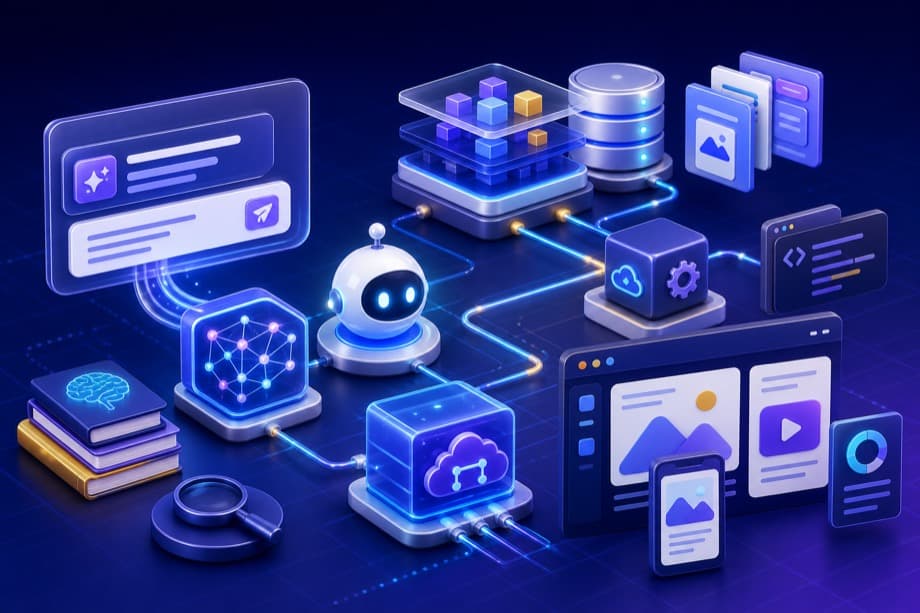
LLM and Generative AI Engineering FoundationsPrompt and Context EngineeringEmbeddings, Vector Search and Knowledge IngestionRAG Engineering and Retrieval Quality
PythonModel APIsOpen modelsNotebooksPydantic
How you will learn
What you will learn, module by module
Build production-grade LLM applications with RAG, AI agents, tool use, orchestration, memory, evaluation and reliable agentic workflows. Progress from LLM and Generative AI Engineering Foundations to Generative and Agentic AI Capstone through guided labs, assessed projects, and portfolio evidence.
01Module 1 · 6 hoursLLM and Generative AI Engineering FoundationsCompare multiple models on a fixed task and create a model-selection scorecard.
Topics you will cover
- Transformer/LLM concepts
- Tokens
- Context windows
- Inference parameters
- Model selection
- Hosted versus open models
- Cost/latency/quality tradeoffs
- Tools and platforms
- Python, Model APIs/open models, Notebooks
- Portfolio evidence
- LLM benchmark sheet
- Assessment
- Model-selection exercise
02Module 2 · 8 hoursPrompt and Context EngineeringCreate robust structured-output prompts with validation and fallback behaviour.
Topics you will cover
- System/user prompts
- Few-shot examples
- Structured outputs
- Schema validation
- Prompt templates
- Context management
- Prompt injection awareness
- Tools and platforms
- Python, Pydantic/JSON Schema
- Portfolio evidence
- Prompt library with tests
- Assessment
- Prompt lab
03Module 3 · 10 hoursEmbeddings, Vector Search and Knowledge IngestionBuild a document ingestion pipeline and searchable knowledge index.
Topics you will cover
- Chunking
- Metadata
- Embeddings
- Vector databases
- Semantic search
- Hybrid retrieval
- Document parsing
- Indexing
- Freshness
- Tools and platforms
- FAISS/Chroma/Pinecone/Weaviate, Python
- Portfolio evidence
- Knowledge ingestion pipeline
- Assessment
- Retrieval lab
04Module 4 · 12 hoursRAG Engineering and Retrieval QualityImprove a baseline RAG system using hybrid retrieval and reranking, then measure quality.
Topics you will cover
- Query rewriting
- Reranking
- Hybrid search
- Citations
- Context packing
- Multi-query retrieval
- Evaluation datasets
- Grounded answer design
- Tools and platforms
- LangChain/LlamaIndex or SDKs, Vector DB, Reranker
- Portfolio evidence
- Measured RAG application
- Assessment
- RAG evaluation report
05Module 5 · 10 hoursTool Use, Function Calling and API IntegrationBuild an assistant that safely calls external tools for search, calculations or business operations.
Topics you will cover
- Tool schemas
- Function calling
- External APIs
- Structured tool results
- Error handling
- Permissions
- Idempotency
- Human approval
- Tools and platforms
- Python, REST APIs, Model SDKs
- Portfolio evidence
- Tool-using AI assistant
- Assessment
- Tool-calling lab
06Module 6 · 12 hoursAgentic AI, Memory and MCP-Style IntegrationsBuild a stateful agent connected to tools and a knowledge source with explicit control boundaries.
Topics you will cover
- Agent roles/goals
- Planning
- Memory types
- State
- Tool routing
- Agent loops
- Protocol-based tool integration
- MCP concepts
- A2A concepts
- Tools and platforms
- Agent framework/SDK, MCP-compatible tooling optional
- Portfolio evidence
- Single-agent production prototype
- Assessment
- Agent architecture review
07Module 7 · 10 hoursMulti-Agent Workflows and Enterprise OrchestrationDesign and implement a multi-step research-to-action workflow with checkpoints and approvals.
Topics you will cover
- Supervisor/worker patterns
- Handoffs
- Deterministic workflows versus autonomy
- Queues
- Long-running tasks
- Human-in-the-loop
- Failure recovery
- Tools and platforms
- Agent framework, Workflow engine optional
- Portfolio evidence
- Multi-agent/workflow demo
- Assessment
- Workflow demo
08Module 8 · 10 hoursEvaluation, Guardrails and Responsible GenAICreate an automated evaluation suite covering quality, safety, groundedness and tool-use correctness.
Topics you will cover
- Golden datasets
- LLM-as-judge with controls
- Hallucination/groundedness
- Safety
- Prompt injection
- PII
- Red teaming
- Policy checks
- Observability
- Tools and platforms
- Evaluation framework, Tracing/observability tools
- Portfolio evidence
- GenAI evaluation dashboard/report
- Assessment
- Evaluation suite review
09Module 9 · 10 hoursProduction Deployment, Observability and CostDeploy a RAG/agent application with tracing, cost tracking, caching and error recovery.
Topics you will cover
- API architecture
- Streaming
- Caching
- Rate limits
- Async jobs
- Secrets
- Tracing
- Token/cost analytics
- Reliability
- Scaling
- Incident readiness
- Tools and platforms
- FastAPI, Docker, Cloud, Observability platform
- Portfolio evidence
- Deployed AI application
- Assessment
- Production-readiness checklist
10Module 10 · 18 hoursGenerative and Agentic AI CapstoneBuild an enterprise-grade AI copilot or agentic workflow with measurable retrieval and task-success metrics.
Topics you will cover
- Problem discovery
- Architecture
- Data ingestion
- RAG
- Tools
- Agents
- Evaluation
- Security
- Deployment
- User experience
- Business KPI
- Tools and platforms
- Full AI application stack
- Portfolio evidence
- Flagship portfolio GenAI/agentic application
- Assessment
- Capstone demo and architecture defence
Projects you will build
2 portfolio projects plus module evidence
Enterprise Knowledge Copilot
Build a RAG assistant over approved enterprise documents with citations, evaluation and guardrails.
Ingestion pipeline · Retrieval benchmark · App · Traces · Evaluation reportAgentic Operations Assistant
Build a tool-using agent that retrieves knowledge, calls APIs and requests human approval for sensitive actions.
Agent architecture · Tools · Tests · Guardrails · Observability · Demo Course value
Why this course
A convincing generative AI portfolio must show grounded retrieval, tool use, agent orchestration, evaluation, guardrails, and reliable deployment—not just prompting.
The curriculum progresses from LLM and Generative AI Engineering Foundations to Generative and Agentic AI Capstone, with guided labs, assessments, and two portfolio projects: Enterprise Knowledge Copilot and Agentic Operations Assistant.
Who this course is for
Developers, ML engineers and technical professionals building LLM, RAG and AI-agent applications.
AdvancedAI & Generative AI Engineer
PrerequisitesLearners should understand Python, APIs, and basic AI/ML concepts. Familiarity with embeddings or cloud services is helpful.
What you will be able to do
- Compare multiple models on a fixed task and create a model-selection scorecard.
- Create robust structured-output prompts with validation and fallback behaviour.
- Build a document ingestion pipeline and searchable knowledge index.
- Improve a baseline RAG system using hybrid retrieval and reranking, then measure quality.
- Build an assistant that safely calls external tools for search, calculations or business operations.
- Deploy a RAG/agent application with tracing, cost tracking, caching and error recovery.
- Build an enterprise-grade AI copilot or agentic workflow with measurable retrieval and task-success metrics.
Technology you will use in this course
PythonModel APIsOpen modelsNotebooksPydanticJSON SchemaFAISSChromaPineconeWeaviateLangChainLlamaIndexVector DBRerankerREST APIs
Career relevance
AI & Generative AI Engineer
This course supports the development of skills relevant to roles such as Generative AI Engineer, Agentic AI Engineer, LLM Application Engineer, and AI Engineer. The strongest learner outcome is a portfolio that shows the problem, implementation, testing or evaluation, documentation and a clear explanation of decisions—not a certificate alone.
Course evidence and instruction
Discuss your learning pathway
Review prerequisites, learning format and project expectations with admissions before enrolment.
Get course guidanceExplore the course projects
Review the project briefs and deliverables to understand the work expected during the course.
Review project expectationsTechnology references
Technology names identify learning tools and do not imply an employer partnership or endorsement.
Microsoft

Clear answers before you enrol
Is the Generative & Agentic AI course suitable for beginners?
This is an advanced-level course. Learners should understand Python, APIs, and basic AI/ML concepts. Familiarity with embeddings or cloud services is helpful.
What will I build during the course?
You will complete guided labs in every module and build two portfolio projects: Enterprise Knowledge Copilot and Agentic Operations Assistant. Deliverables include working files or code, documentation, testing or evaluation evidence, and a final presentation.
Which tools and platforms are covered?
Key tools include Python, model APIs, open models, notebooks, Pydantic, JSON Schema, FAISS, and Chroma. Additional platforms are introduced in relevant modules through practical tasks, and the toolset may evolve as industry practice changes.
How long does the course take?
The course includes approximately 106 guided learning hours across 10 modules, delivered over 8 weeks.
Which career paths can this course support?
The curriculum supports the development of skills relevant to roles such as Generative AI Engineer, Agentic AI Engineer, LLM Application Engineer, and AI Engineer. Career outcomes depend on prior experience, project quality, interview readiness and market conditions; employment is not guaranteed.
Will I receive mentor and career support?
The course includes live instruction, lab support, assignment feedback, project reviews and career preparation covering portfolio development, CV writing, LinkedIn profile improvement, and interview guidance.
Ready to start?
A-56, Sector-64, Noida, Uttar Pradesh – 201301Ready to start your Generative AI, RAG & Agentic AI Engineering journey?
Review the full curriculum, experience a live class and confirm the right starting point before enrolling.